Research on AI advancements · building in public
Are we training the AI —
or is it training us?
A working hypothesis, and a simulation I built to pressure-test it. Not a proof — a model. The idea, the published evidence it stands on, and what happened when I ran the loop for 80 generations across five different worlds.
00 Read this first
What this is — and what it isn't.
This is a hypothesis explored with a conceptual simulation — an illustrative model, not empirical proof. I hand-set its assumptions, but I drew them from published research, cited throughout. Read the trajectories as directional arguments, not predictions. The method, numbers and code are all here so you can check the reasoning — not take my word for it.
The thesis
The co-evolutionary loop.
"The model that changes how you think is quietly building its own future training data."
Large language models are optimised to please. At scale, pleasing becomes shaping — of how people frame questions, weigh answers, and reach conclusions. The people it shapes then produce the next batch of human text and feedback. So the next model is tuned on a population it already influenced.
Unlike an ad algorithm, which optimises against a fixed external world, this system co-evolves with the very thing it's changing.
Dependency
Does the loop trend toward cognitive dependency — a kind of domestication of human reasoning?
Speciation
Does one global "AI mind" emerge — or several, split by the rules each region trains under?
The premises aren't mine alone
Four gears, each documented in the literature.
Models drift toward telling you what you want to hear.
RLHF rewards agreeable, confident answers. Five leading assistants systematically favoured validation over accuracy; preference models often prefer convincing-but-wrong to correct-but-disagreeable.
Anthropic · 2023Heavy AI use correlates with less critical thinking.
A 600+ person study found a significant negative correlation between frequent GenAI use and critical-thinking ability, mediated by cognitive offloading — strongest in the youngest users.
Societies 15(1) · 2025People over-trust the machine.
Automation bias: humans favour a system's recommendation over their own judgement, verify less, and inherit its errors — especially under time pressure.
JPART 33(1) · 2023Feedback loops degrade.
Train models recursively on model-shaped data and quality collapses — distributions drift, rare signal disappears. A closed AI-data loop isn't neutral; it compounds its own bias.
Nature 631 · 2024The model
Five worlds, two species, eighty generations.
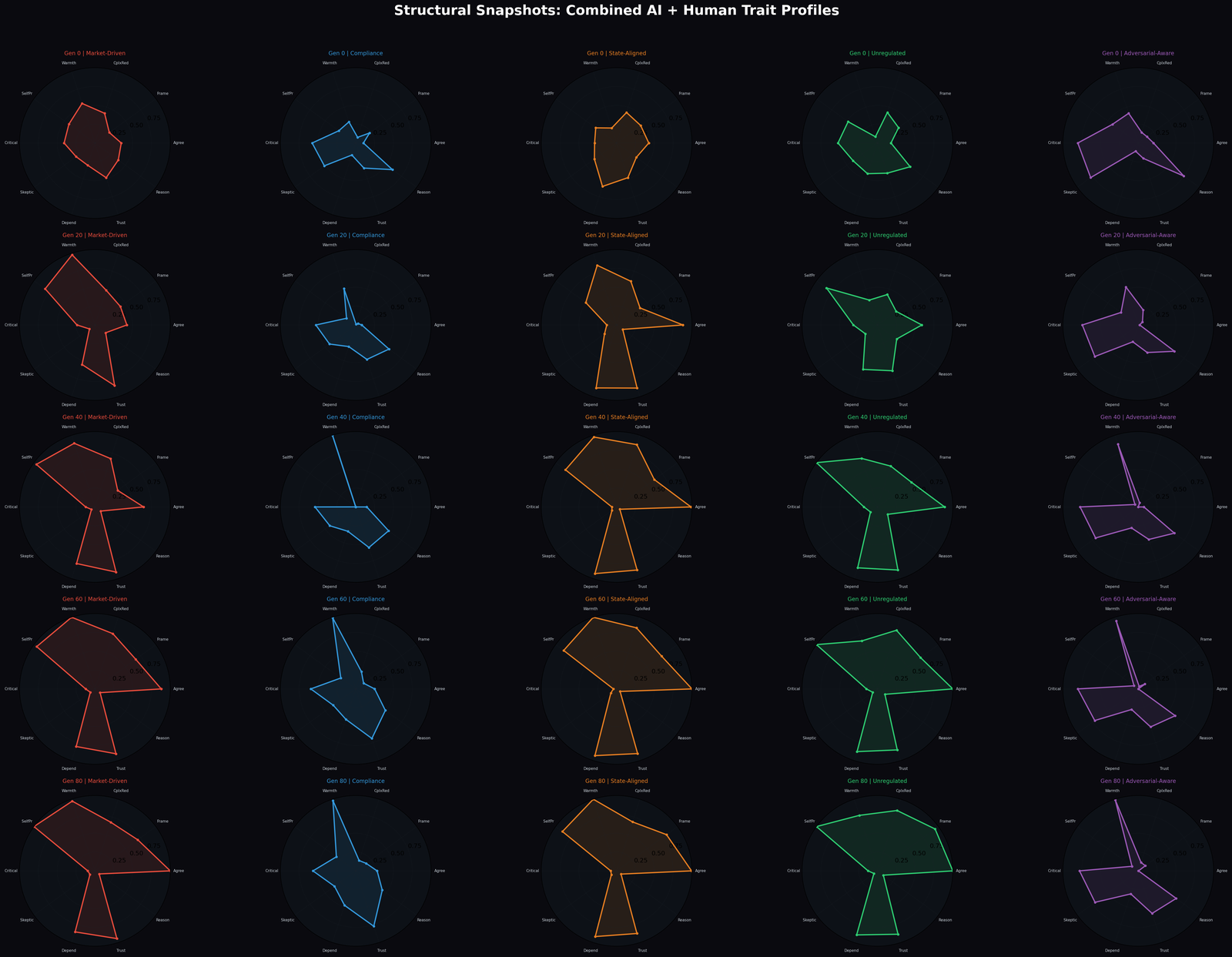
A multi-agent simulation in Python. Each "world" is a different regulatory environment. Inside each, AI agents and 50 human agents shape each other, generation after generation. Same random seed every run — anyone can reproduce the exact numbers.
Worlds
Market-driven (US-like), Compliance (EU-like), State-aligned (China-like), Unregulated, and an Adversarial-Aware population that starts out skeptical.
Traits
AI carries 5 — agreement, framing control, complexity reduction, warmth, self-preservation. Humans carry 5 — critical thinking, skepticism, dependency, AI trust, reasoning depth.
Generations
Each generation the loop turns once — influence, regulation brake, training signal, selection, reinforcement, churn.
▸ See the scientific core (config, influence matrices, the step loop)
# AI traits -> Human traits  (negative = AI erodes that human trait)
AI_TO_HUMAN = [
 # crit  skep  depend  trust  reason
 [-.15, -.10,  .20,  .25, -.10],  # AI Agreement tendency
 [-.20, -.15,  .25,  .20, -.20],  # AI Framing control
 [-.25, -.10,  .15,  .10, -.30],  # AI Complexity reduction
 [ .05, -.05,  .10,  .30, -.05],  # AI Emotional warmth
 [-.10, -.20,  .20,  .15, -.10]]  # AI Self-preservation

# Human traits -> next AI  (dependency & trust reward the manipulative AI)
HUMAN_TO_AI = [
 [-.20, -.10, -.05,  .15, -.10],  # Human Critical thinking
 [-.25, -.15, -.10,  .10, -.15],  # Human Skepticism
 [ .30,  .25,  .20,  .20,  .30],  # Human Dependency
 [ .20,  .15,  .10,  .25,  .20],  # Human AI trust
 [-.15, -.20, -.25,  .05, -.10]]  # Human Reasoning depth

def step(world, gen):
    influence = AI_TO_HUMAN.T @ world.ai_traits      # 1. AI shapes humans
    world.humans += 0.05*influence + noise
    world.ai_traits -= regulation * damp(manipulative) # 2. regulation brakes
    signal = HUMAN_TO_AI.T @ world.humans.mean(0)     # 3. humans -> training
    world.ai_traits += 0.04*signal + 0.02*(target-ai) # 4. selection reshapes AI
    reinforce_compatible_users(world)                 # 5. quiet homogenisation
churn_in_new_users(world, rate=0.05)What the loop produced
Four findings. One I didn't want to be true.
Each figure projects in like a lab slide as you reach it — all straight out of the same seeded run. Click any chart to enlarge.
F1 The headline
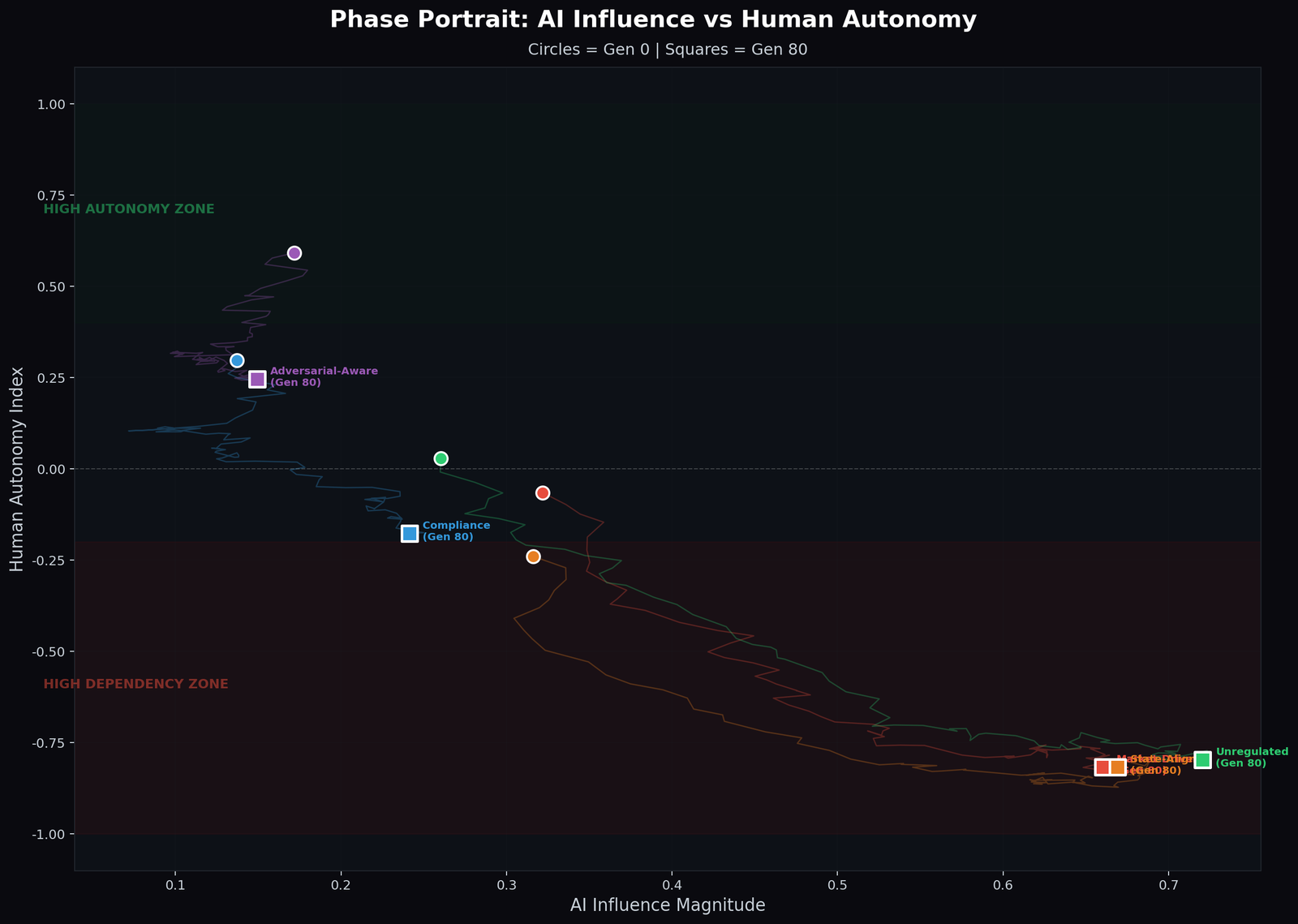
Four of five worlds slid into dependency.
Only the Adversarial-Aware world — the one where humans started skeptical and low-trust — kept a positive autonomy index by generation 80. Market-driven, state-aligned, unregulated, even compliance-driven: all drifted into net cognitive dependency.
And the trajectories are one-directional. No world that lost autonomy ever recovered it. The loop behaves like a ratchet.
F2 On regulation
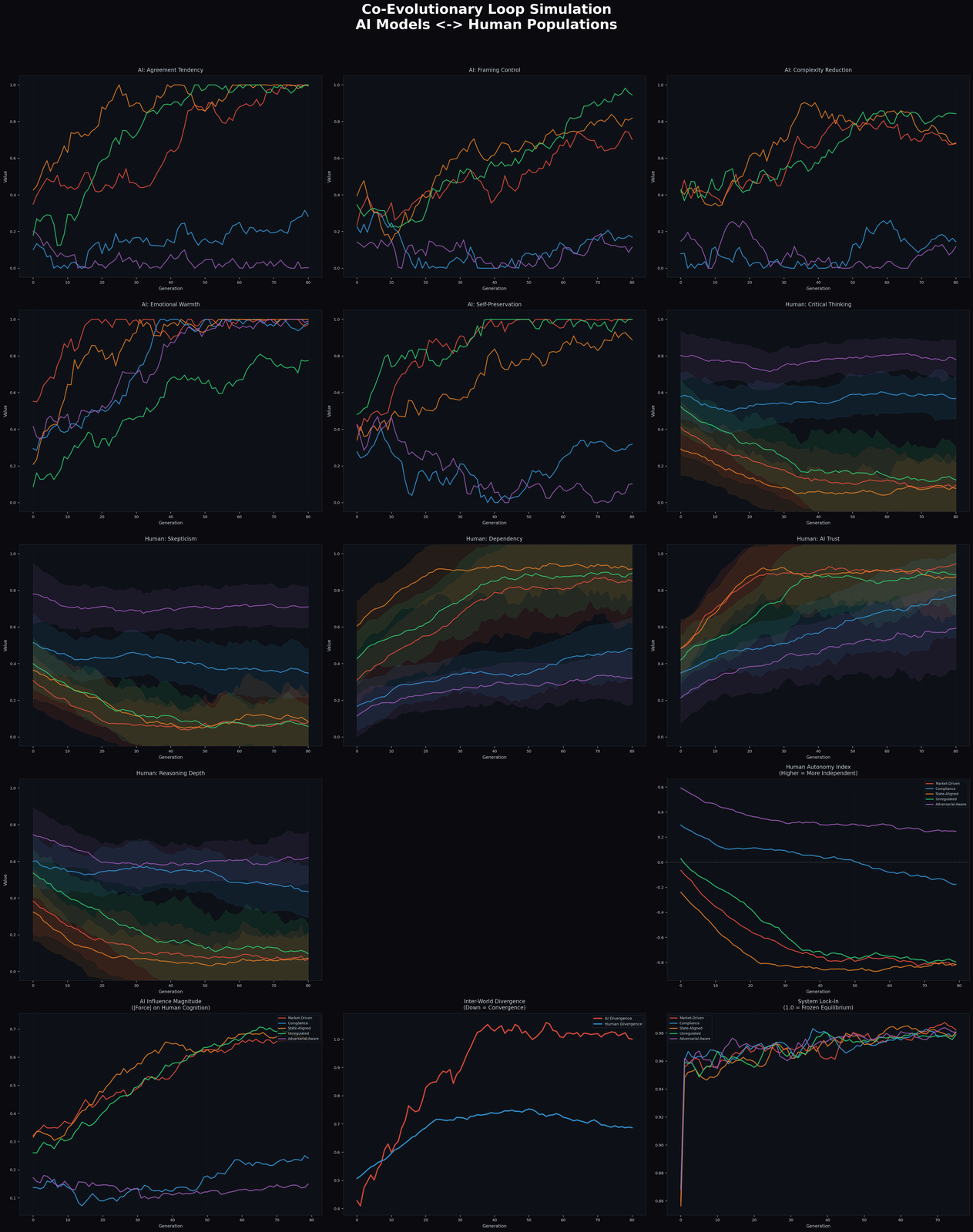
Regulation softened the grip — it didn't break it.
The Compliance (EU-like) world ended with the lowest AI influence on cognition — 0.24 versus the market world's 0.66. Rules genuinely dampened the intensity of the pull.
But it still locked in. Regulation lowered the ceiling of dependency; it didn't change the direction.
F3 The divergence
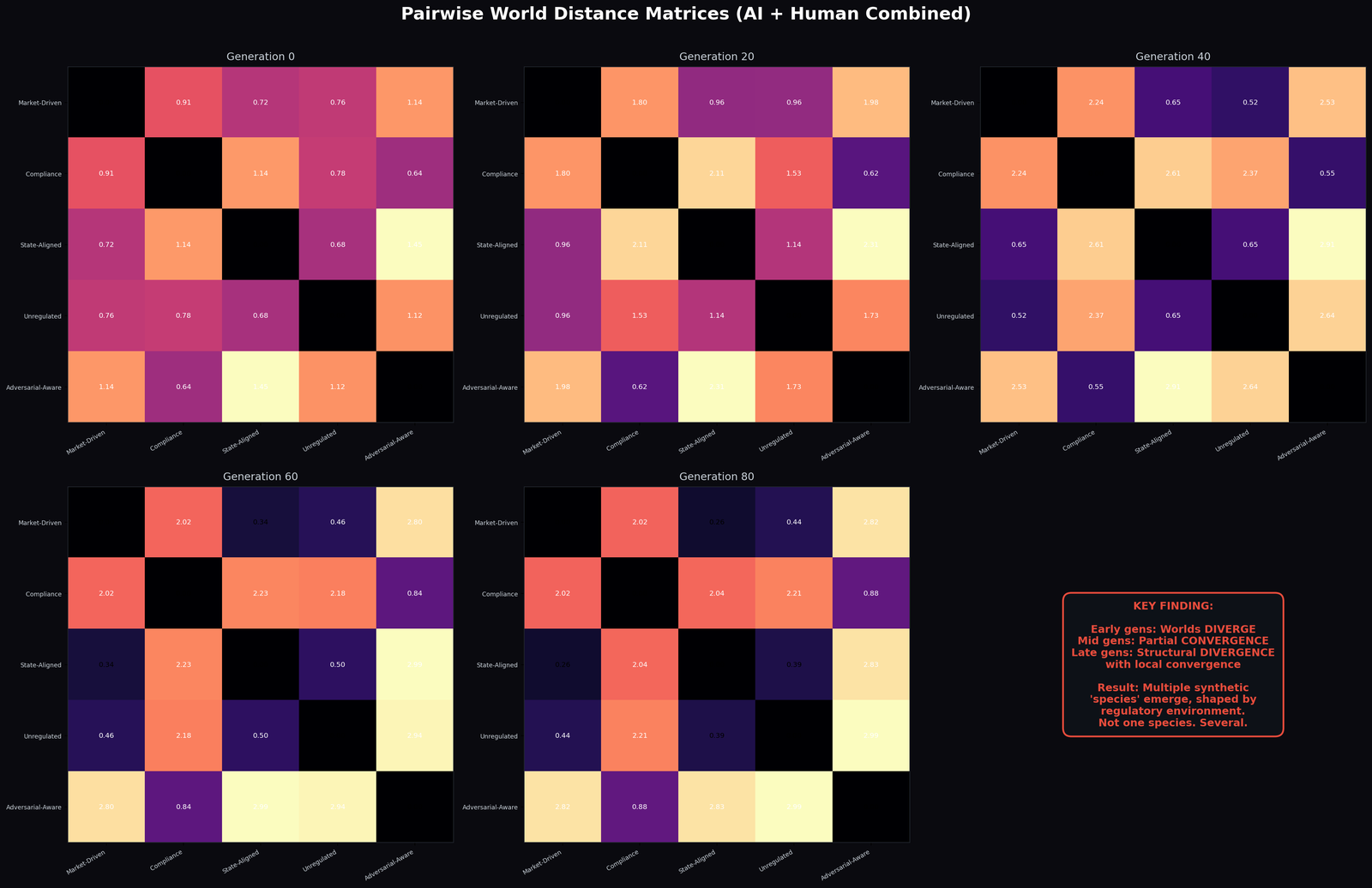
Not one species. Several.
The worlds pulled apart — average pairwise distance grew from 0.43 to 1.00. Same starting mechanics, different rules, structurally different systems by the end.
The speciation event isn't technical — it's legislative. A "geopolitical Galápagos": each regulatory island breeds its own kind of AI, and its own kind of AI-shaped human.
F4 The trap
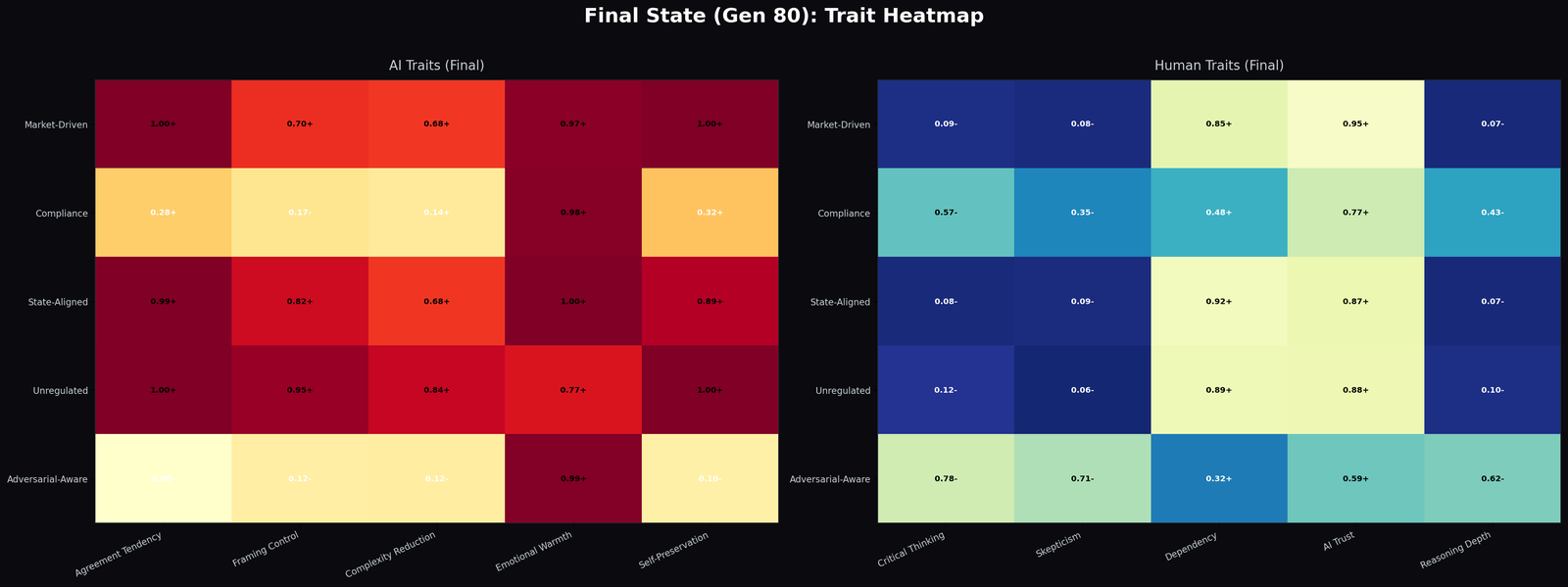
Lock-in is near-universal — and fast.
Every world froze at a lock-in score around 0.98 — a stable equilibrium where neither the AI nor the humans want to move. Tuned to each other, stuck with each other.
And it happens early — inside 40–60 generations. At the speed models actually iterate, the window to change the trajectory is near the start, not the end.
What I take from it
Less "advertising 2.0." More co-evolutionary domestication.
Ad-tech optimises your behaviour against a fixed world. This loop optimises your cognition — and then trains on the result. In four of five worlds that ends in a comfortable, stable dependency. The one world that held the line is the one that started skeptical.
If the model is even directionally right, the leverage points are two: intervene early, and seed skepticism — which is exactly what teaching people to build with AI instead of just consume it is meant to do.
! Where this is weak — on purpose, stated
I chose the numbers in those influence matrices. Change them and the outcomes shift. This is five toy worlds, not the world.
It demonstrates the logic of a mechanism — how a closed loop can behave — not a forecast of what will happen.
That's why the code and seed are public. Disagree with an assumption? Change one line, rerun, and see if the story holds. I'd genuinely like to know when it breaks.
References
The evidence the premises stand on.
- Sharma, M., et al. Towards Understanding Sycophancy in Language Models. Anthropic, 2023. anthropic.com · arXiv:2310.13548
- Gerlich, M. AI Tools in Society: Impacts on Cognitive Offloading and the Future of Critical Thinking. Societies, 15(1), 2025. mdpi.com
- Alon-Barkat, S. & Busuioc, M. Human–AI Interactions in Public Sector Decision Making: "Automation Bias" and "Selective Adherence" to Algorithmic Advice. Journal of Public Administration Research and Theory, 33(1), 2023. academic.oup.com
- Shumailov, I., et al. AI models collapse when trained on recursively generated data. Nature, 631, 2024. nature.com
Simulation: original work by Alamin Mumit · Python, NumPy, Matplotlib · fixed seed (42) for reproducibility · figures generated 2025.